AI Agent Architecture: A Complete Guide for 2026
By Andrew Pyle

Artificial intelligence has evolved beyond static prediction models into dynamic systems capable of autonomous decision-making and action. Understanding ai agent architecture is essential for professionals who want to build reliable, scalable AI systems that can perceive their environment, reason about problems, and execute actions without constant human oversight. This architectural foundation determines how effectively agents can learn from experience, collaborate with other systems, and adapt to changing business requirements.
Core Components of AI Agent Architecture
The foundation of any effective ai agent architecture begins with understanding its essential building blocks. These components work together to enable agents to function autonomously while maintaining reliability and predictability in production environments.
Perception Layer
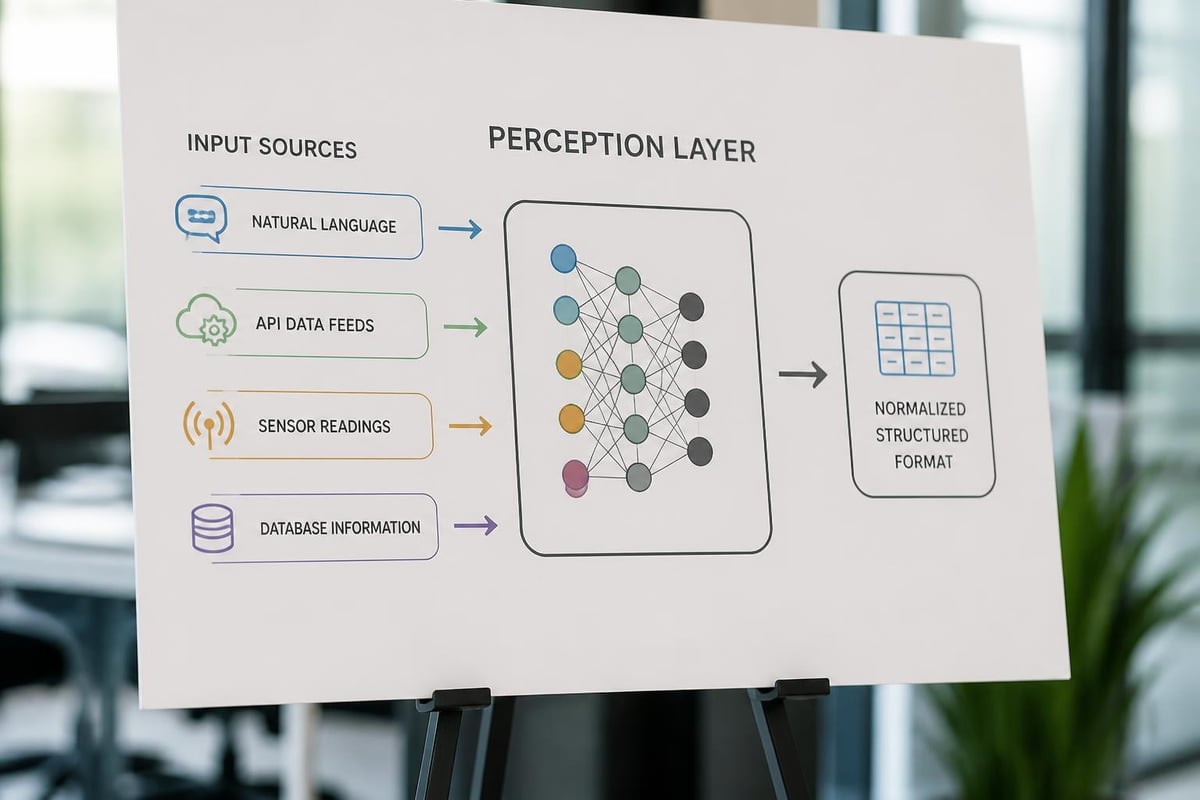
The perception layer serves as the agent's interface with the external world. This component processes incoming data from various sources, including user inputs, API responses, sensor readings, and database queries. Modern perception systems employ natural language processing for text understanding, computer vision for visual data, and structured data parsers for traditional information formats.
Key responsibilities of the perception layer include:
- Receiving and normalizing input data from multiple sources
- Converting raw information into structured formats
- Filtering noise and irrelevant information
- Maintaining context awareness across interactions
- Validating input quality and completeness
The perception layer's design directly impacts how well an agent understands its operating environment. For instance, a customer service agent needs robust natural language understanding to interpret user intent, while a monitoring agent in real estate applicationsalytics.
Reasoning and Decision Engine
The reasoning component represents the cognitive core of ai agent architecture. This engine evaluates the perceived information, applies domain knowledge, and determines appropriate actions. The design patterns for reasoning enginesnd use case.
| Reasoning Approach | Best For | Complexity Level | Resource Requirements |
|---|---|---|---|
| Rule-Based Systems | Predictable workflows | Low | Minimal |
| Retrieval-Augmented Generation | Knowledge-intensive tasks | Medium | Moderate |
| Chain-of-Thought | Multi-step problems | High | Significant |
| Tree of Thoughts | Complex decision spaces | Very High | Extensive |
Simple agents might use straightforward if-then logic, while sophisticated systems employ large language models with advanced prompting strategies. The reasoning engine must balance decision quality with response time, particularly in business-critical applications where delays impact user experience.
Action Execution Layer
Once decisions are made, the action execution layer translates intentions into concrete operations. This component manages interactions with external systems, databases, APIs, and user interfaces. Effective ai agent architecture proper error handling and rollback capabilities.
The execution layer typically implements:
- Action validation to ensure safety and permission compliance
- API integration for external service communication
- Transaction management for maintaining data consistency
- Error handling with retry logic and fallback strategies
- Logging and monitoring for observability and debugging
Memory Systems and State Management
Memory architecture separates effective agents from simple automation scripts. AI agents require both short-term memory for maintaining conversation context and long-term memory for learning from historical interactions.
Short-Term Memory
Short-term memory maintains the immediate context of current interactions. This includes conversation history, temporary variables, and the agent's current state within a workflow. Most implementations use session storage or in-memory caches with time-limited retention.
Designing efficient short-term memory involves balancing context window limitations with the need for comprehensive understanding. Agents working with large language models face token constraints that require strategic pruning of older context while preserving critical information.
Long-Term Memory
Long-term memory enables agents to recall past interactions, learn from successes and failures, and personalize experiences. Implementation options range from vector databases for semantic search to traditional relational databases for structured information retrieval.
Common long-term memory patterns:
- Episodic memory stores specific interaction histories
- Semantic memory maintains factual knowledge and relationships
- Procedural memory records successful action sequences
- Working memory combines short and long-term elements dynamically
The architecture of memory systemsrsonalized experiences across multiple interactions. Organizations building customer-facing agents must carefully consider data retention policies, privacy requirements, and retrieval performance.
Planning and Orchestration Mechanisms
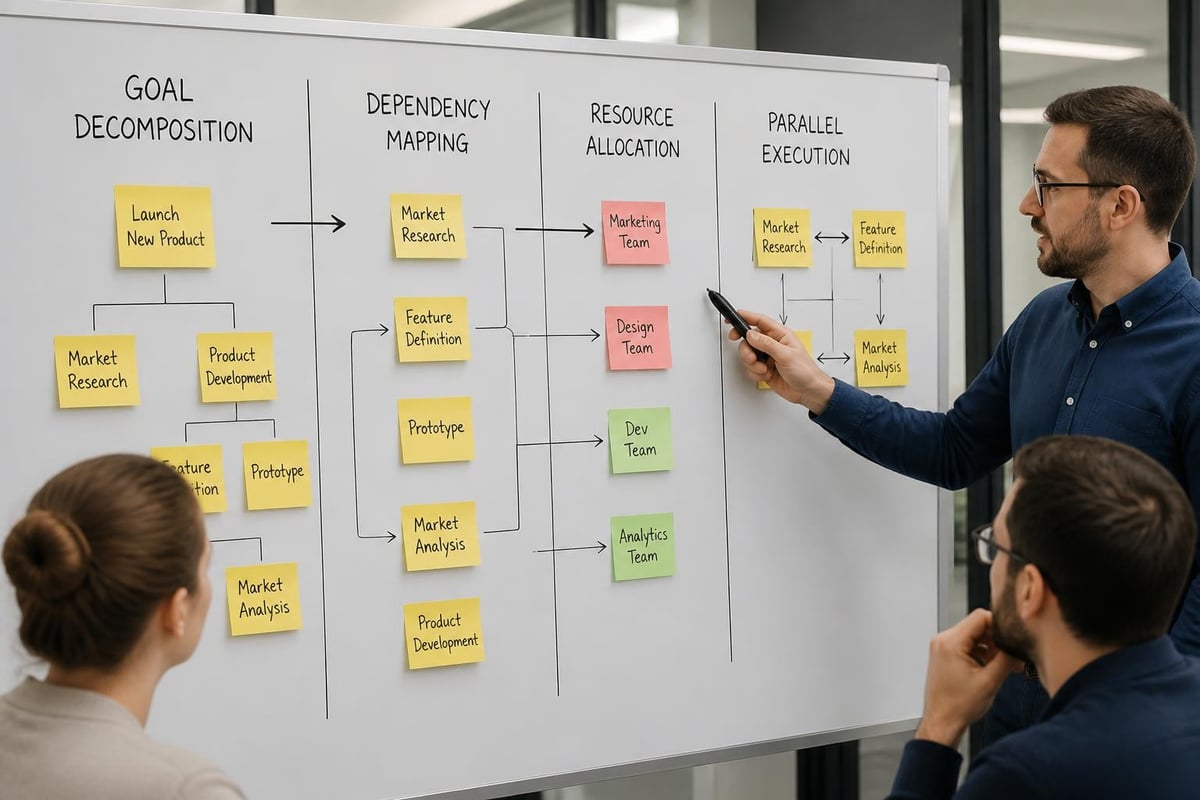
Advanced ai agent architecture includes planning capabilities that enable agents to decompose complex goals into achievable subtasks. Planning mechanisms range from simple linear workflows to sophisticated multi-step strategies with conditional branching.
Hierarchical Task Networks
Hierarchical task networks organize goals into tree structures where high-level objectives break down into progressively more concrete actions. This approach works well for domains with well-defined procedures and predictable workflows.
For example, an agent helping with data analysis might decompose "analyze sales trends" into subtasks like data collection, cleaning, statistical analysis, visualization generation, and report compilation. Each subtask can be further decomposed until reaching executable primitive actions.
Reactive Planning
Reactive planning systems generate action sequences dynamically based on current observations rather than pre-computing entire plans. This approach offers greater flexibility in unpredictable environments but requires more sophisticated decision-making capabilities.
Agents using reactive planning continuously assess their environment and adjust strategies in real-time. This pattern suits scenarios where conditions change frequently, such as resource optimization or dynamic scheduling applications.
Tool Integration and External Capabilities
Modern agents extend their capabilities through external tools and APIs. The tool integration layer of ai agent architecture defines how agents discover, select, and invoke external resources to accomplish tasks beyond their core competencies.
Effective tool integration requires:
- Tool registration and discovery with clear capability descriptions
- Parameter mapping to transform agent intentions into API calls
- Response parsing to interpret results and integrate them into workflows
- Error handling for unavailable or failing services
- Rate limiting and quota management for external API usage
Understanding how AI agent buildersmeworks provide standardized interfaces for common operations like web searching, database queries, calculation execution, and file manipulation.
The design of tool interfacesficient access to accomplish tasks while preventing unauthorized actions or data exposure. Implementing proper authentication, authorization, and audit logging ensures secure tool usage.
Architectural Patterns for Different Use Cases
AI agent architecture varies significantly based on application requirements, complexity levels, and operational constraints. Selecting the right pattern influences development speed, maintenance costs, and system reliability.
ReAct Pattern (Reasoning and Acting)
The ReAct pattern interleaves reasoning and action steps, allowing agents to think through problems while gathering information iteratively. This architecture works well for research tasks, troubleshooting, and investigative workflows where the solution path isn't predetermined.
A ReAct agent follows this cycle:
- Thought: Reason about the current situation and next steps
- Action: Execute a specific operation or query
- Observation: Process the results and update understanding
- Repeat: Continue until the goal is achieved or constraints are met
ReWOO Pattern (Reasoning Without Observation)
ReWOO architecture separates planning from execution, generating complete action plans before beginning execution. This pattern reduces API calls and improves efficiency for tasks with predictable workflows. However, it trades flexibility for speed, making it less suitable for dynamic environments.
Reflection Pattern
Reflection-based architectures enable agents to critique and improve their own outputs. After generating initial responses or plans, a reflection component evaluates quality, identifies weaknesses, and suggests improvements. This self-correction capability significantly enhances output quality for creative and analytical tasks.
| Pattern | Planning Approach | Best Use Cases | Adaptability | API Efficiency |
|---|---|---|---|---|
| ReAct | Iterative | Research, investigation | High | Lower |
| ReWOO | Upfront | Predictable workflows | Low | Higher |
| Reflection | Iterative with review | Content creation, analysis | Medium | Medium |
Multi-Agent Systems and Collaboration
Complex business problems often require multiple specialized agents working together. Multi-agent ai agent architecture defines how agents communicate, coordinate, and collaborate to achieve shared objectives while maintaining individual specializations.
Agent Coordination Strategies
Centralized coordination employs a supervisor agent that assigns tasks, manages dependencies, and aggregates results from worker agents. This pattern provides strong consistency but creates a potential bottleneck and single point of failure.
Decentralized coordination allows agents to communicate peer-to-peer, negotiating responsibilities and sharing information directly. This approach offers better scalability and fault tolerance but requires more sophisticated conflict resolution mechanisms.
Hierarchical coordination combines both approaches, organizing agents into layers with increasing abstraction levels. Higher-level agents set strategic direction while lower-level agents handle operational details.

Communication Protocols
Effective multi-agent systems require standardized communication protocols defining message formats, routing mechanisms, and state synchronization. Common approaches include message queues, shared databases, and direct API calls.
Organizations building multi-agent systems must consider:
- Message serialization and schema evolution
- Asynchronous vs. synchronous communication patterns
- Conflict resolution when agents have competing goals
- Load balancing and failover strategies
- Observability across distributed agent networks
Security and Safety Considerations
Production ai agent architecture must address security risks and safety concerns inherent in autonomous systems. Agents with execution capabilities can potentially cause harm through unintended actions, security vulnerabilities, or adversarial manipulation.
Input Validation and Sanitization
All agent inputs require rigorous validation to prevent injection attacks, prompt manipulation, and data poisoning. Implementing input filters, content moderation, and adversarial testing helps identify vulnerabilities before deployment.
Particular attention must be paid to indirect prompt injection, where malicious instructions are embedded in external data sources the agent processes. Robust architectures implement multiple validation layers and maintain strict separation between instructions and data.
Action Constraints and Guardrails
Limiting agent capabilities through explicit constraints prevents catastrophic failures. Implementing proper guardrailsource limits, requiring human approval for sensitive operations, and maintaining audit logs.
Essential safety mechanisms:
- Whitelist-based action authorization
- Rate limiting to prevent resource exhaustion
- Monetary or resource budgets for costly operations
- Human-in-the-loop validation for high-stakes decisions
- Rollback capabilities for reversible actions
- Monitoring and alerting for anomalous behavior
Performance Optimization and Scalability
Production-grade ai agent architecture requires careful attention to performance characteristics and scalability patterns. Agents must respond quickly while managing computational costs and infrastructure requirements.
Caching and Memoization
Intelligent caching reduces redundant processing and API calls. Agents can cache tool results, LLM responses, and intermediate computations. Cache invalidation strategies must balance freshness requirements with performance gains.
Memoization at the reasoning level allows agents to reuse previous decision-making processes for similar situations. This pattern particularly benefits agents handling repetitive workflows with minor variations.
Asynchronous Processing
Many agent tasks don't require immediate responses. Implementing asynchronous processing through message queues or background workers improves responsiveness and resource utilization. Users receive acknowledgment instantly while agents process complex requests in the background.
Horizontal Scaling Patterns
As demand grows, ai agent architecture must support horizontal scaling. Stateless agent designs facilitate scaling by allowing multiple instances to handle requests independently. Shared memory systems require distributed caching solutions or database clustering to maintain consistency across instances.
Monitoring, Observability, and Debugging
Operating AI agents in production demands comprehensive monitoring and debugging capabilities. Unlike traditional software, agent behavior emerges from complex interactions between components, making issues harder to diagnose and resolve.
Telemetry and Instrumentation
Effective monitoring captures multiple signal types:
- Performance metrics: Response times, throughput, resource usage
- Quality metrics: Task completion rates, user satisfaction scores
- Cost metrics: API usage, token consumption, infrastructure expenses
- Safety metrics: Constraint violations, failed validations, unusual patterns
Distributed tracing helps track requests across multiple components and external services. Each agent interaction generates a trace showing perception inputs, reasoning steps, tool invocations, and final actions.
Debugging Strategies
Debugging autonomous agents requires visibility into their decision-making process. Modern architecturesng chains, confidence scores, and alternative options considered.
Replay capabilities allow developers to reconstruct exact agent states and re-execute decision processes with different parameters. This testing approach helps validate fixes and improvements before production deployment.
Implementation Frameworks and Platforms
Organizations building AI agents can leverage existing frameworks that provide common architectural components and best practices. Popular options include LangChain, AutoGen, CrewAI, and various commercial platforms.
When evaluating frameworks, consider:
- Component coverage: Does it provide all necessary architectural layers?
- Flexibility: Can you customize components for specific requirements?
- Integration ecosystem: What tools and services connect easily?
- Production readiness: Does it support monitoring, scaling, and deployment?
- Learning curve: How quickly can your team become productive?
Building custom architectures offers maximum control but requires significant development effort. Framework-based approaches accelerate development but may impose constraints on architectural decisions. Many organizations start with frameworks for rapid prototyping then selectively customize components as requirements crystallize.
Data Management and Training Strategies
Effective ai agent architecture includes mechanisms for continuous improvement through data collection and training. Agents generate valuable interaction data that informs model fine-tuning, prompt optimization, and architectural refinements.
Feedback Collection
Capturing user feedback, success metrics, and failure cases creates training datasets for improvement. Explicit feedback like ratings and corrections provides clear signals, while implicit signals like task completion and retry attempts indicate quality issues.
Organizations can leverage this feedback to create synthetic datasetstion helps explore edge cases and rare scenarios without waiting for natural occurrence.
Continuous Learning Pipelines
Production agents benefit from continuous learning pipelines that regularly update models, prompts, and decision logic based on accumulated experience. This requires infrastructure for data versioning, experiment tracking, model registry, and gradual rollout mechanisms.
Balancing stability with improvement necessitates careful testing of updates. A/B testing, canary deployments, and shadow mode operation allow validating changes before full deployment.
Building effective AI agents requires deep understanding of architectural principles, component interactions, and production considerations. From perception layers and reasoning engines to memory systems and multi-agent coordination, each element contributes to reliable autonomous behavior. Whether you're developing customer service bots, data analysis assistants, or workflow automation agents, these architectural patterns provide the foundation for success. Andrew J. Pylesinesses master AI agent architecture through clear explanations, practical examples, and actionable guidance that transforms complex concepts into deployed solutions.